
















C, Z, and U Purlins Production, Applications and Selection Guide
Despite their inconspicuous appearance, purlins play a vital role in steel-framed buildings. Located between the primary steel framework and the exterior cladding, they bear the full load imposed on the building envelope and safely transmit this weight to the main structure. Consequently, purlins are critical to the performance of both steel roofing and wall cladding systems. C, Z, and U-section purlins are the three most common types; although they vary in shape and intended application, they all serve the same fundamental structural purpose.
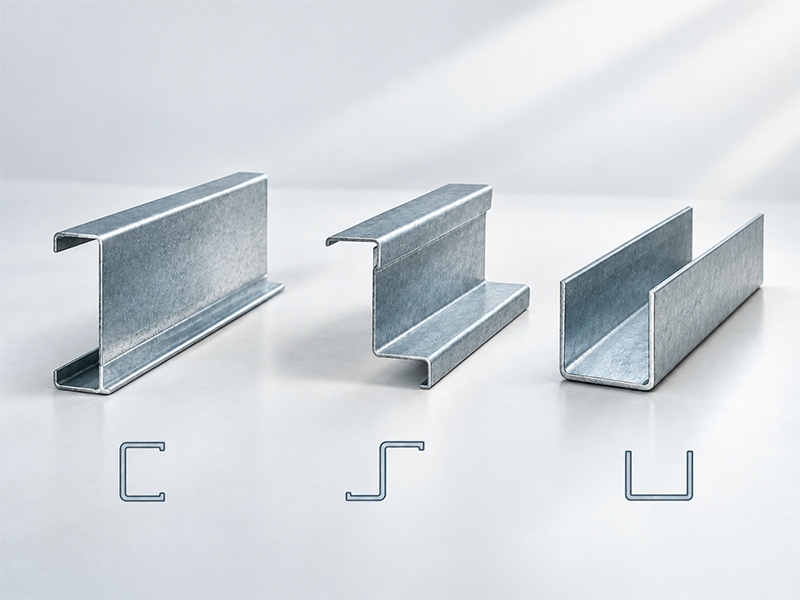
Basic Differences Between C, Z and U Purlins
C Purlins
C Purlins feature a simple C-shaped section with two flanges facing the same direction. They are widely used for small and medium-span roofs and walls. Contractors also frequently use them for floor framing, door and window surrounds, and other light steel work.
The biggest advantage of C Purlins is practicality. They are light in weight, easy to cut, handle and install on site, which helps speed up overall construction progress.
Z Purlins
Z Purlins have flanges facing opposite sides. This unique shape allows adjacent purlins to overlap at joints. The overlapping structure creates better overall continuity across long spans and strengthens the whole roofing system.
This is why Z Purlins are the top choice for large industrial buildings, including warehouses, factories and logistics parks where long-span roofs are required.
U Purlins
U Purlins, also called channel purlins, are rarely used as primary roof supports. In most projects, they work as secondary framing members. They are ideal for structural reinforcement, equipment support brackets, as well as door and window frame fixing. Whenever a channel-section profile fits the connection design, U Purlins are the most suitable option.
How Steel Purlins Are Manufactured
All standard C, Z and U purlins are cold-formed from steel coils.
Production starts by selecting qualified steel coils according to required thickness, material grade and coating standard. The steel strip runs through a full set of rolling machines, which gradually bend the flat steel into standard purlin profiles.
After forming, all sections are cut to custom lengths based on project needs. Bolt holes can be pre-punched in the factory to match construction drawings. Pre-fabrication greatly reduces on-site cutting and drilling work, saving construction time.
Every batch of finished purlins is inspected strictly. Workers check dimensions, profile shape, hole positions and length before packaging and delivery.
Surface coating directly affects service life. Hot-dip galvanized steel is the most common option for regular anti-corrosion needs. For coastal or harsh environments, Galvalume and ZAM coatings provide stronger rust resistance. Note that primer-only treatment offers limited protection. For long-term outdoor use, additional topcoat painting is usually necessary.
Standard Sizes and Specifications
Purlin models are named after their profile shape and depth. For example, C200 and Z200 mean 200mm deep C-type and Z-type purlins. Common standard depths cover 100mm to 300mm. Imperial sizes from 4 inches to 12 inches are also available.
For cold-formed purlins, the regular thickness ranges from 1.5mm to 3.0mm. Thicker materials are used for heavy-load conditions. Flange width, lip size and overall length can all be customized.
At Ecosteel Source, we offer C, Z, and U sections with customization options like cutting and punching based on project drawings or samples.
How to Choose the Right Purlin Type
Profile selection mainly depends on span length, actual load and structural function.
Use C purlins for conventional roofs and walls with medium or short spans. They fit most ordinary steel building framing perfectly.
Choose Z purlins for long-span roofs and multi-bay industrial buildings. The overlapping connection design delivers better structural stability over long distances.
Apply U purlins for secondary support, local reinforcement and special connection parts, instead of main roof framing.
Keep in mind that profile shape is only one part of the selection process. Structural performance also depends on purlin depth, thickness, steel grade, installation spacing and connection methods.
Final Notes
Purlins are secondary components, yet they directly affect the stability and installation quality of wall and roof systems.
Selecting the correct purlin type and specification helps avoid material waste, reduces on-site installation problems, and ensures long-term building stability. Matching C, Z or U purlins to the building's actual load, span and working environment is always the most cost-effective and reliable solution for steel structure projects.