


PPGI vs. PPGL: What's the Difference and Where Are They Used?
What Is PPGI?
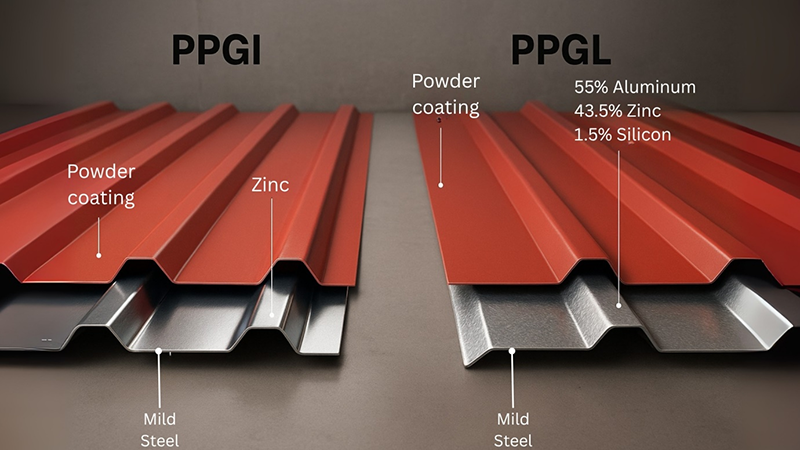
PPGI stands for Pre-Painted Galvanized Iron/Steel. The base is a Galvanized Steel Sheet — meaning it has a zinc coating — and then an organic paint system is applied on top. The zinc does the heavy lifting for corrosion protection, while the paint adds color, weather resistance, and a clean finish.
You'll see different paint systems on the market: PE, SMP, HDP, and PVDF. Which one you choose depends on how much sun, rain, and temperature swing the material will face, plus how important color retention and flexibility are for your project.
PPGI is popular because it hits a nice balance between cost, corrosion resistance, appearance, and formability. It's a practical pick for general construction, indoor use, or moderately exposed outdoor applications. Common examples include roofing sheets, wall panels, ceiling tiles, doors, appliance panels, office furniture, and all sorts of fabricated steel products.
What Is PPGL?
PPGL is pre-painted Galvalume Steel. Instead of a plain zinc coating, the substrate uses an aluminium-zinc alloy — typically around 55% aluminium, 43.4% zinc, and 1.6% silicon.
The aluminium forms a barrier that resists corrosion and handles heat well. The zinc still provides sacrificial protection, meaning it will corrode first to protect the steel if the coating gets scratched. That combination makes PPGL a strong choice for outdoor applications where sun, moisture, and shifting weather are constant factors.
You'll find PPGL in metal roofing, wall cladding, industrial buildings, warehouses, Sandwich Panels, and other building envelope systems. It also comes in a wide range of colors and surface finishes, so it can pull double duty as both a protective and decorative material.
How Are They Made?
The production process for both is pretty similar.
First, the steel substrate gets its metallic coating — either zinc for PPGI or the aluminium-zinc alloy for PPGL. Then the surface is treated to help the paint stick and to improve corrosion resistance. A primer goes on, followed by one or more topcoats. The whole thing passes through an oven to cure the paint.
What you end up with is a multilayer material: steel substrate, metallic coating, pretreatment layer, primer, and topcoat.
Manufacturers can adjust the paint system, color, gloss level, and surface texture depending on the application. PE is the economical choice with good flexibility. SMP and HDP offer better weathering performance. PVDF is what you pick when long-term UV resistance and color retention are non-negotiable.
PPGI or PPGL: Which One Should You Choose?
The main difference is the metallic coating under the paint.
PPGI uses Galvanized Steel. It's generally more economical and offers good formability and corrosion protection for many standard applications.
PPGL uses Galvalume steel. Its aluminium-zinc coating usually provides better resistance to atmospheric corrosion, heat, and oxidation — making it a solid option for demanding outdoor environments.
But that doesn't mean PPGL is always the “better” choice. If your project has moderate exposure and cost is a big factor, PPGI can be the smarter solution. If you're dealing with roofing or wall systems exposed to harsh weather, high temperatures, or long-term outdoor service, PPGL might give you better value over the life of the building.
What About Coils and Sheets?
Both PPGI and PPGL come in coils and pre-cut sheets.
Coils are for manufacturers who do further processing — roll forming, slitting, profiling, stamping. They're commonly used to make roofing panels, wall cladding, and other finished components. If you have a production line, coils are usually the way to go.
Pre-cut sheets are more convenient for projects that need fixed dimensions and can be installed right after delivery. The choice often comes down to your production equipment, order volume, transportation, and installation requirements.
Common Applications
These days, PPGI and PPGL show up in all sorts of places:
Metal roofing and corrugated sheets
Wall cladding and facade panels
Sandwich panels
Warehouses and industrial buildings
Residential and commercial buildings
Refrigerator and washing machine panels
HVAC and ventilation equipment
Containers and transportation equipment
Office furniture and storage systems
They can also be formed into different profiles, which makes them suitable for both functional and decorative uses. Corrugated roofing sheets are probably the most familiar example.
Choosing the Right Product
When you're picking between PPGI and PPGL, the paint color is only one small part of the spec. You also need to think about steel grade, substrate coating, coating thickness, paint system, steel thickness, and the service environment.
A standard PE coating might be perfectly fine for a general building. But if the project needs stronger UV and weather resistance, SMP, HDP, or PVDF could be worth the extra cost.
The right product isn't necessarily the one with the highest specification. It's the one that matches the actual environment, processing requirements, expected service life, and budget. Get that balance right, and you'll have a material that performs well without over-spending.
PPGI and PPGL each bring their own advantages. With the right substrate and coating system, pre-painted steel delivers a practical mix of durability, appearance, formability, and cost efficiency — which is why it remains a go-to choice for modern construction and industrial applications.